There’s a point in a lawn’s decline where regular upkeep stops producing results.
It doesn’t happen overnight. It happens slowly — a few more bare patches each year, moss that spreads a little further, grass that fills in a little less. Most homeowners adjust their expectations gradually, not realizing the lawn has crossed a line where maintenance alone can no longer catch up.
That’s when lawn restoration in the Portland metro area becomes the right answer — not more mowing, more fertilizer, or another round of moss killer.
Ground Up Services works with homeowners across Portland who have been maintaining their yards for years without making real progress. In most cases, the problem isn’t effort. It’s that the foundation has deteriorated to a point where routine care is just managing the decline, not reversing it.
Don’t wait until spring to find out how bad it’s gotten. Contact Ground Up Services now for an honest assessment of where your lawn actually stands.
Bare Spots That Keep Coming Back in the Same Places
If you’ve reseeded the same areas two or three times and grass won’t hold, the problem isn’t the seed.It’s what the seed is landing in.
Bare spots that repeat season after season usually indicate:
- Severe compaction preventing root establishment
- Thatch too thick for seedlings to reach soil
- Drainage issues keeping the area too wet
- Shade levels grass can’t survive long-term
Reseeding without addressing these conditions produces the same result every time — brief germination, then die-off. The soil has to be corrected first.
Moss Covering More Than a Third of the Surface
Some moss is part of life in Portland. Widespread moss is a different problem.
When moss covers 30–40% or more of a lawn, it’s not just a moss issue — it means the grass population has thinned enough to give moss the room it needs to establish. At that point:
- Moss killer alone creates bare patches where new moss fills in
- Overseeding alone can’t compete with existing moss coverage
- The grass that remains is usually too thin to recover through normal growth
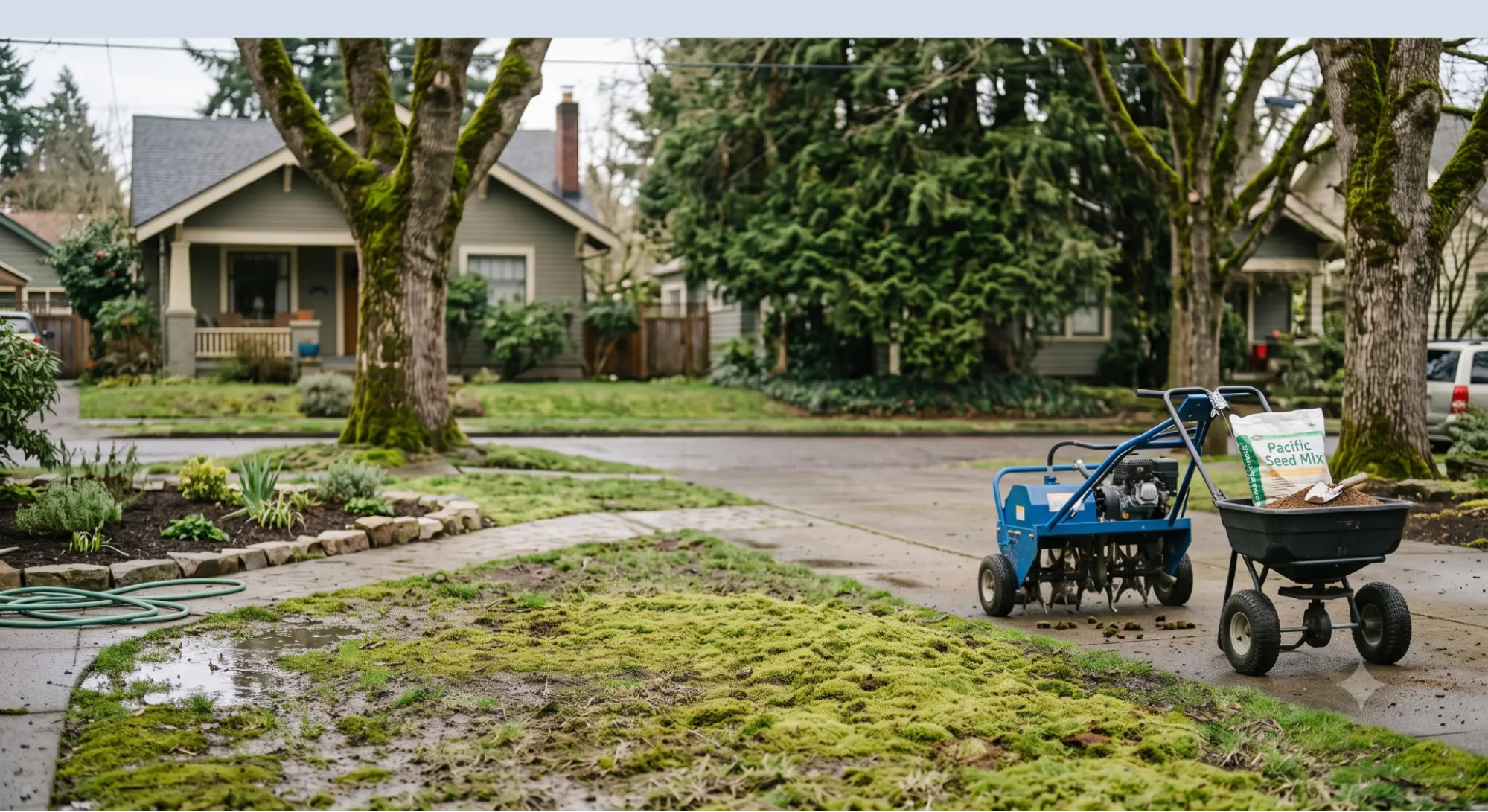
Lawn renovation in the Portland metro area at this stage requires a combination of dethatching, soil correction, and heavy overseeding — with moss control built into the plan rather than treated separately.
Ground Up Services’ restoration process is built around this kind of multi-step recovery.
Grass That Stays Thin Even During Peak Growing Season
A Portland lawn in good health should look visibly dense from April through October.
If yours looks thin during those months — not drought-stressed, not recently mowed, just genuinely sparse — the seed population has dropped below a sustainable level. Causes typically include:
- Accumulated thatch blocking light and air to the crowns
- Soil so compacted roots can’t anchor new growth
- Years of gradual thinning that compound season over season
- Variety mismatch — grass that was seeded for conditions that no longer exist
Thin grass in summer is one of the clearest signs that basic maintenance is no longer making a dent.
Water Sitting in Multiple Areas After Rain
Isolated drainage problems can often be addressed with targeted fixes. When water is sitting in several different areas of the yard after a normal Portland rain, that’s a broader issue.
It typically points to:
- Compaction across a large portion of the lawn
- Grading problems that are directing water to low points
- A thatch layer that’s blocking surface absorption
- Clay content that has become too dense to drain effectively
Standing water doesn’t just inconvenience — it suffocates grass roots, accelerates moss growth, and compounds compaction with every rainstorm.
Ground Up Services also handles landscape construction for cases where grading or structural drainage work is part of the solution.
The Lawn Never Recovered from a Hard Winter
Some winters in Portland hit lawns harder than others. Extended cold, prolonged rain, or periods of standing water can damage root systems significantly.
If your lawn took a hit during winter and hasn’t come back to its previous density — even after a full growing season — it’s unlikely to recover on its own. The grass population that survived is simply not enough to fill back in naturally in a reasonable timeframe.
Waiting another year usually means:
- More ground lost to moss and weeds
- Further soil deterioration
- A larger, more expensive restoration project down the road
Why Routine Maintenance Can’t Fix a Foundation Problem
Mowing, fertilizing, and occasional overseeding are tools for maintaining a lawn that’s already functioning reasonably well.
When the soil is severely compacted, when thatch has built up for multiple seasons, when the grass population has dropped below a viable density — these tools are no longer adequate. They improve appearance briefly without changing what’s happening underneath.
That’s the cycle most homeowners are stuck in: brief improvement, then decline, then trying the same things again.
What Restoration Actually Looks Like
Lawn renovation in the Portland metro area, done properly, is a reset — not a patch job.
A full restoration typically involves:
- Heavy dethatching to clear the organic layer
- Core aeration to break up compacted soil
- Soil amendment to improve structure and drainage
- Heavy overseeding with locally appropriate varieties
- Moss treatment integrated into the plan
- Followed by a consistent maintenance schedule to protect the investment
The goal is to bring the lawn back to a condition where normal maintenance can actually keep up with it.
When to Call in Professional Help
If your lawn has been on a slow decline for more than one season — or if you’ve been patching the same problems repeatedly without real progress — it’s worth getting an outside assessment.
Ground Up Services has been doing lawn restoration across the Portland metro area since 2001. We’ll tell you honestly whether restoration is what’s needed, and if so, exactly what that involves.
Book a restoration evaluation today — and find out what your lawn actually needs to recover properly.